
We started writing LLM evals after the third production regression. Turns out they're just unit tests for AI agents. Here's the build.
We started writing LLM evals after the third production regression. Turns out they're just unit tests for AI agents. Here's the build.
TL;DR
- LLM evals are the unit tests of AI agent work. If you're not writing them, regressions will find your clients before you do.
- We started writing them after the third production regression. Same story every time: a prompt change breaks a downstream behaviour silently.
- This post is for builders shipping real production agents who want a repeatable way to catch breakage before it goes live.
LLM evals are automated checks that verify your agent still behaves the way you intended after every change. They're the unit tests of LLM work. And if you haven't written any yet, you're flying blind.
What are LLM evals and why do they matter?
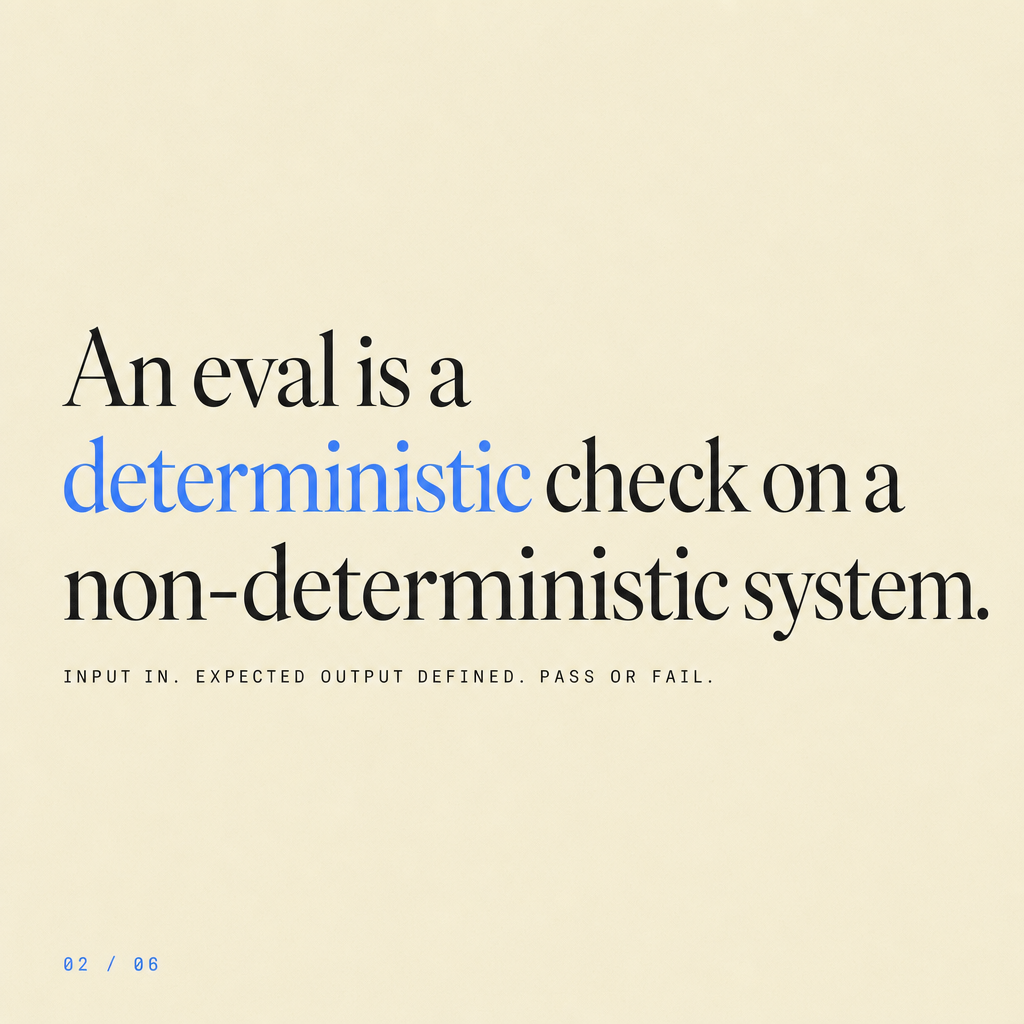
LLM evals are test cases that check whether your language model outputs match expected behaviour given a known input.
Think of them the way a developer thinks about unit tests. You write a test that says: given this input, the model should respond in this way. You run the test after every change. If it breaks, you know before you deploy. Without LLM evals, you're relying on manual spot-checking or, worse, client complaints to surface regressions. Neither scales. Neither protects your reputation.
For AI agent builders, evals matter even more than they do in traditional software. Model behaviour can shift with a single prompt edit. A word change in a system prompt can alter tone, compliance posture, or the entire decision branch. You need a fast way to know when that happens.
What problem do LLM evals actually solve?
They catch silent regressions. The changes that don't throw an error but break the intended behaviour anyway.
The production regression pattern is predictable. You tweak a prompt to fix one thing. Something else shifts. The agent starts handling an edge case differently. Nobody notices until a client calls. By then the damage is done.
This is the specific failure mode LLM evals guard against. Not syntax errors. Not crashed workflows. The subtle drift where the agent's tone hardens, or it stops collecting a required field, or it starts offering information it shouldn't. That kind of breakage is invisible to logs. Evals make it visible.
You can read more about how prompt description choices affect downstream behaviour in this post on why code description is now the bottleneck.
How do you structure an LLM evals architecture in production?
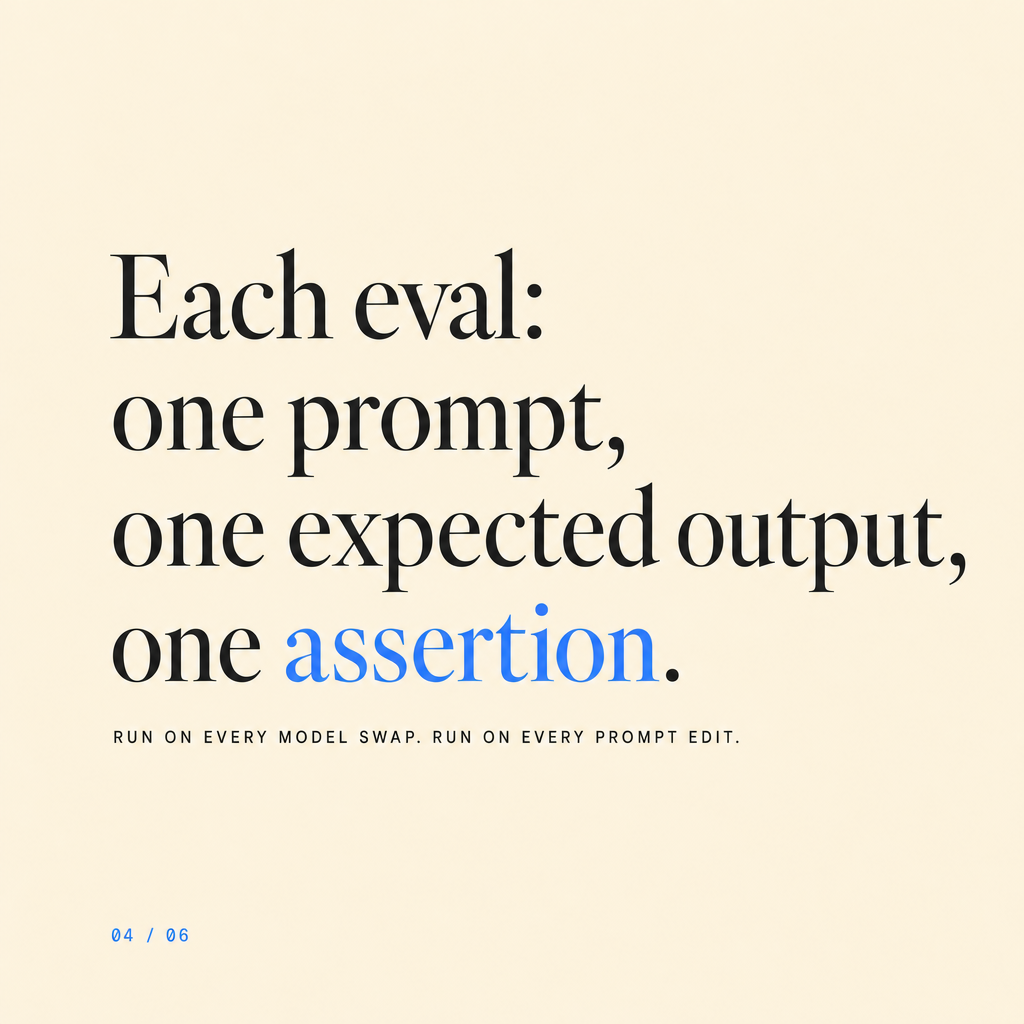
You need three things: a set of fixed test inputs, a defined expected output or rubric, and a runner that checks the two against each other after every deploy.
The inputs are real examples drawn from production. Actual edge cases. The scenarios that burned you. The rubric can be exact-match for structured outputs, or LLM-as-judge for open-ended responses where you need a model to score another model. The runner sits in your CI pipeline or triggers on every N8N workflow deploy.
For anyone building on N8N, the cost structure here is worth thinking about carefully. A self-hosted instance gives you the freedom to run evals on every change without per-execution billing. That matters when you're running dozens of test cases on every push. For context on how infrastructure cost shapes build decisions, see this breakdown on managed agents vs N8N agent cost.
A working eval suite for a production voice agent typically covers:
- Intent classification: does the agent recognise what the caller wants?
- Field extraction: does it collect the right data without being prompted twice?
- Compliance guardrails: does it stay within scope and avoid prohibited topics?
- Tone consistency: does it match the persona defined in the system prompt?
- Handoff triggers: does it escalate correctly when the condition is met?
What are the real trade-offs with LLM evals?
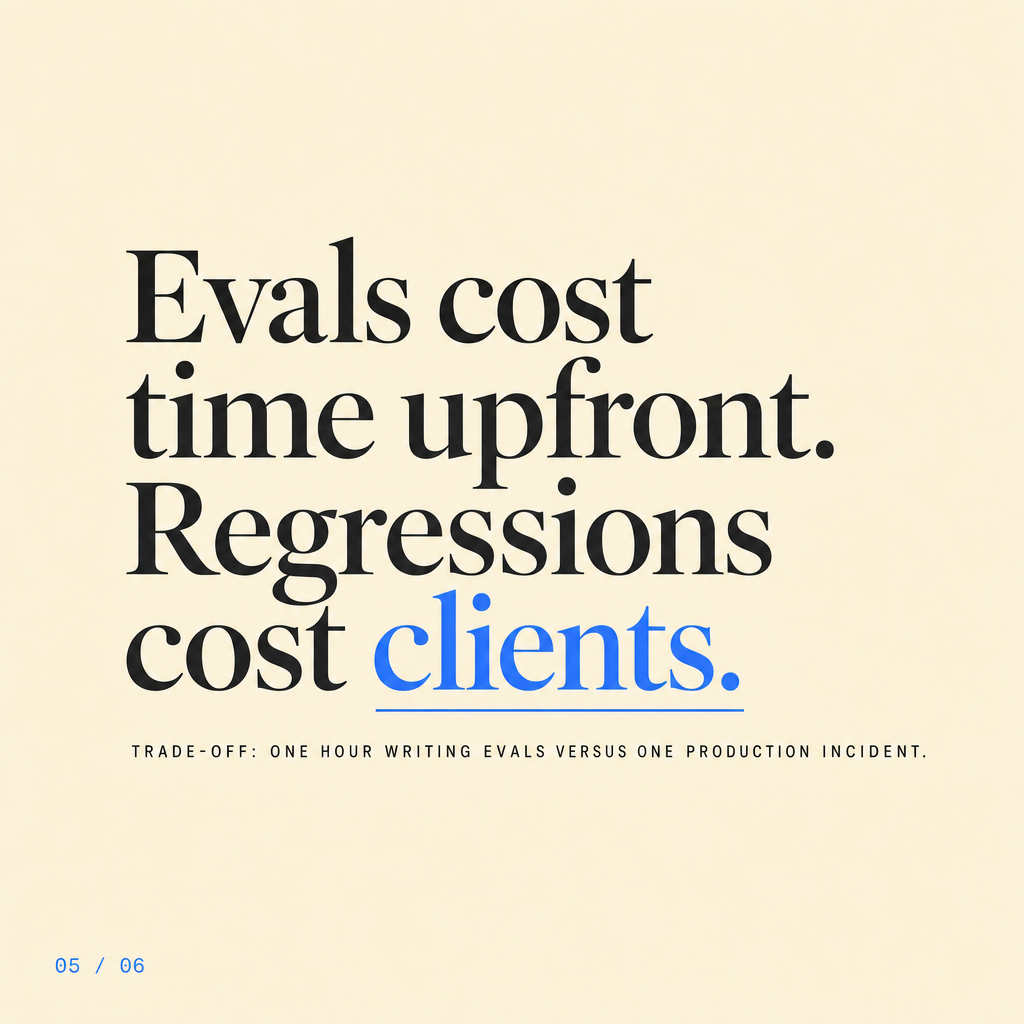
Writing evals takes time upfront. Not writing them costs more time later, just distributed across incidents you didn't plan for.
The most common objection is that it slows down shipping. It does, briefly. But a production regression in a voice agent calling finance broker leads has real consequences. Compliance exposure. Broken client trust. Manual cleanup. The upfront cost of writing evals is small compared to any of those.
The other trade-off is eval quality. A bad eval gives you false confidence. If your rubric is too loose, the test passes and the regression still ships. LLM-as-judge approaches help here, but they introduce their own variability. The Gartner research on AI reliability reinforces the industry-wide consensus: testing and monitoring LLM outputs is non-negotiable for production deployments.
The best time to write your first eval was before your first production regression. The second best time is now.
Key Takeaways
- LLM evals are the unit tests of AI agent work. They catch silent regressions before your clients do.
- Start with real production edge cases as your test inputs. Don't write theoretical scenarios.
- The cost of not writing LLM evals shows up as incidents, not as time on a sprint board.
If your production agents don't have LLM evals yet and you want a second set of eyes on the build, DM AUDIT and I'll send you five questions. We'll work out whether your current setup is exposed and what it'd take to fix it.
Frequently Asked Questions
Written by Syed Bilgrami
Founder of TheAutomate.io, building AI voice agents for Australian businesses