
Running a two-track agency means knowing which clients get the self-serve path and which ones need a bespoke build. Get it wrong and everyone loses.
Running a two-track agency means knowing which clients get the self-serve path and which ones need a bespoke build. Get it wrong and everyone loses.
TL;DR
- Not every client needs a self-serve setup. Routing them correctly saves time on both sides.
- Bespoke builds earn their cost when the workflow is genuinely complex or compliance risk is real.
- This post is for builders and operators deciding which track to put a new client on.
Not every client needs a custom build. The right call is usually obvious once you know what signals to look for. Self-serve handles most of them.
What does a two-track agency actually look like?
One track is self-serve. The other is bespoke. The job is routing clients correctly before you waste anyone's time.
The self-serve track is a productised offering. A fixed scope, a predictable setup process, and a price that doesn't change per client. The bespoke track is everything else. Custom logic, custom integrations, a scoped brief, and a build timeline that reflects the actual complexity.
Most clients assume they need bespoke. Most of them don't. The default assumption costs builders hours in discovery calls and costs clients money they don't need to spend.
When is self-serve the right call?
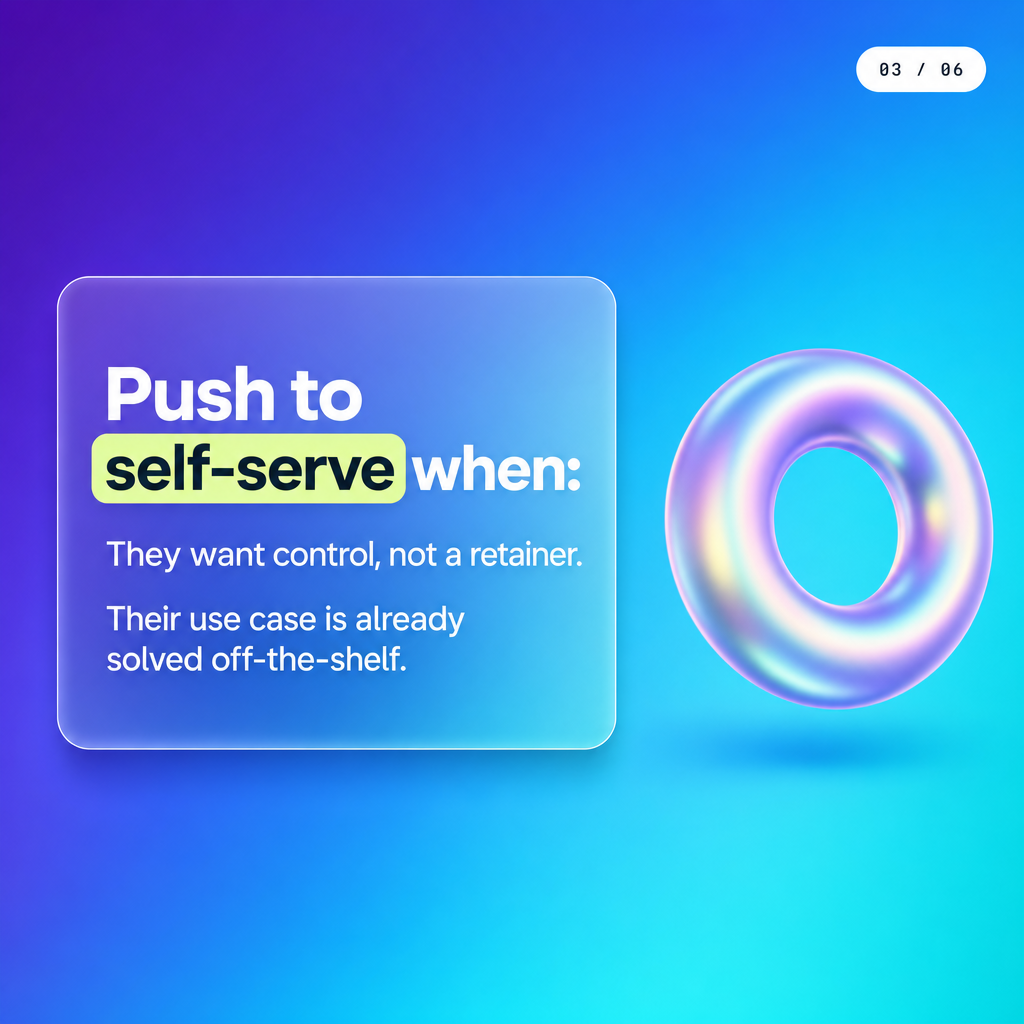
Push a client toward self-serve when their use case is standard, their stack is common, and the thing they need already exists.
For most Australian service businesses in finance, insurance, or real estate, the core need is the same: answer inbound enquiries, qualify leads, and pass the good ones to a human. That's a solved problem. There's no reason to build it from scratch each time.
Self-serve signals to watch for:
- Their CRM is GHL, HubSpot, or another platform with native integrations
- Their call flow has fewer than four decision branches
- They don't have an existing system that needs to talk to the new one
- Compliance requirements are standard (ACMA, DNCR registration, basic Privacy Act obligations)
- They want to be live quickly and have budget discipline
If five of five boxes tick, stop talking and point them at the signup pipeline. Don't dress up a product as a project.
When does a client actually need a bespoke build?
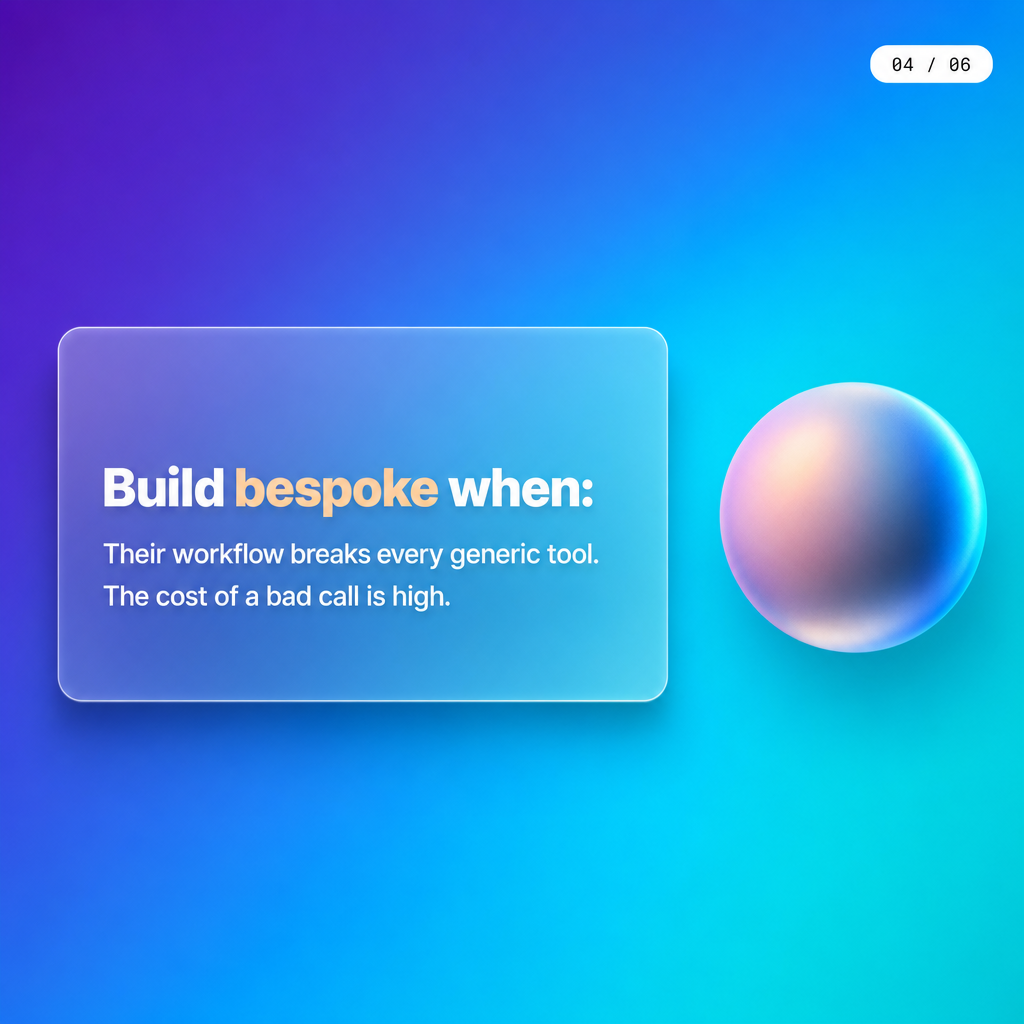
Bespoke earns its place when the workflow has genuine complexity that a productised tool can't handle without breaking something important.
The honest version: most clients who ask for bespoke are really asking for reassurance that someone's paying attention to their specific situation. That's a different thing. But some situations genuinely require custom work.
Bespoke signals that mean it:
- Legacy CRM with no off-the-shelf connector (Pipedrive with custom fields, an internal system, or similar)
- Multi-step qualification logic with conditional branching that changes based on prior answers
- Regulated product lines where the agent script needs legal review before it goes live
- Hand-off logic that routes to different team members based on lead type, geography, or urgency
- Volume or infrastructure requirements that a shared-resource product can't meet
For context on how hand-off logic can make or break a build, hand-off design for a four-person broker team covers exactly what breaks and why.
What's the cost of routing a client to the wrong track?
Getting the routing wrong is expensive for both sides. A self-serve client pushed into bespoke burns budget and time. A bespoke client forced onto a standard product breaks within weeks.
The first error is the more common one. A client with a simple inbound qualification need gets quoted a custom build because the conversation drifted toward edge cases. They spend more, wait longer, and end up with something no one maintains well.
The second error is quieter but messier. A client with real complexity signs up for a self-serve product. It works until it doesn't. Then they're back asking for changes the product was never designed to support.
Australia's ACMA guidelines on automated outbound calls are a useful gut check here. If the client's use case sits near any regulatory grey area, that alone can push a build from self-serve to bespoke. Compliance requirements aren't edge cases. They're scope.
How does pricing signal which track a client belongs on?
Pricing is a routing tool. A fixed low-cost product filters out clients who actually need bespoke. That's a feature, not a problem.
A self-serve product at a predictable monthly rate attracts clients who know roughly what they need and want to move fast. They're not looking to workshop requirements for a fortnight. They want a working agent. The product does the qualification.
Bespoke pricing, scoped per project, signals that discovery, custom logic, and ongoing iteration are part of the deal. Clients who need that will pay for it. Clients who don't will gravitate toward the product. That separation keeps both tracks healthy.
The reasoning behind the self-serve price point at TheAutomate.io is documented in why we picked $99 + GST, no contract, hard stop at 10 free calls. The short version: the price is designed to be a filter, not just a number.
Key Takeaways
- Self-serve is the right default. Most Australian service businesses have a standard use case that a productised offering handles cleanly.
- Bespoke is justified by genuine complexity: legacy systems, conditional logic, regulated scripts, or non-standard hand-off requirements.
- Routing errors are expensive in both directions. A client on the wrong track will eventually make that clear, usually at the worst time.
- Pricing is part of the routing system. A well-set self-serve price filters clients to the track that actually fits them.
If you're not sure which track a potential client belongs on, the answer is usually a short scoping conversation before any proposal goes out. Five questions, twenty minutes. That's the audit.
DM me AUDIT and I'll send you the five questions I use to route new clients before I quote anything.
Frequently Asked Questions
Written by Syed Bilgrami
Founder of TheAutomate.io, building AI voice agents for Australian businesses