
Storing call state inside the model's context window feels simple until a call drops or a retry fires. Here's why production agents write progress to Postgres instead.
Storing call state inside the model's context window feels simple until a call drops or a retry fires. Here's why production agents write progress to Postgres instead.
TL;DR
- Production agents that rely on context window state alone break when calls drop, retry, or hand off mid-conversation.
- Persisting call progress to Postgres means any retry picks up exactly where the last attempt stopped.
- If you're shipping voice AI for real clients, state management is the architecture decision that matters most.
Production agents need somewhere reliable to store what's happened during a call. The model's context window isn't that place. Postgres is.
Why Does Context Window State Break Production Agents?
Context window state is ephemeral. The moment the call ends, the connection closes, or the model resets, everything in that context is gone.
For a demo build, that's fine. The call completes cleanly, no retries, no handoffs, no dropped connections mid-qualification. But real calls don't behave that way. A lead's mobile drops. A Retell AI webhook times out. The agent gets restarted because a new model version was deployed. Any of those events wipes the context clean. The agent starts over. The lead gets asked the same questions again. They hang up.
This is the failure mode that doesn't show up in testing. It shows up at 7pm on a Tuesday when a finance broker's best lead of the week calls back and gets treated like a stranger.
What Does Postgres State Persistence Actually Look Like?
At the start of every call, the agent writes a session row to Postgres. Every meaningful step writes an update. Every retry reads that row first.
The structure is simple. You've got a call ID, a contact ID, a status field, and a JSON column that holds whatever the agent has collected so far. Loan purpose, property value, suburb. Whatever the qualification script needs.
When a retry fires, the agent doesn't start from scratch. It reads the Postgres row, sees what's already been confirmed, and picks up from the next unanswered question. The lead doesn't notice. The broker gets a complete record.
This is the same pattern used in any stateful background job. The agent is just a worker. Postgres is the job queue and the audit log rolled into one.

Does Storing State Outside the Model Cost More?
The infrastructure cost is predictable and well below the cost of a bad call experience.
A Postgres instance sized for typical voice agent session volume adds a modest, fixed line to your stack. It doesn't scale with call volume the way model tokens do. Speaking of which, if you're already thinking carefully about what goes into the model's context on each turn, you're already doing cost control. Keeping state in Postgres actually helps here. You write a structured summary back to the context rather than re-injecting a full conversation transcript.
That's a smaller prompt on every retry. Fewer tokens. Lower cost per call. The voice agent cost breakdown post covers how those per-call costs stack up across model, telephony, and TTS. State persistence is one of the levers that keeps that number flat.

How Do Production Agents Handle Retries With Persistent State?
Retry logic becomes simple when the agent can read exactly what it last confirmed.
Without Postgres, a retry means choosing between two bad options. Re-run the full call from the top and annoy the lead, or skip qualification and send the broker an incomplete record. Neither is good.
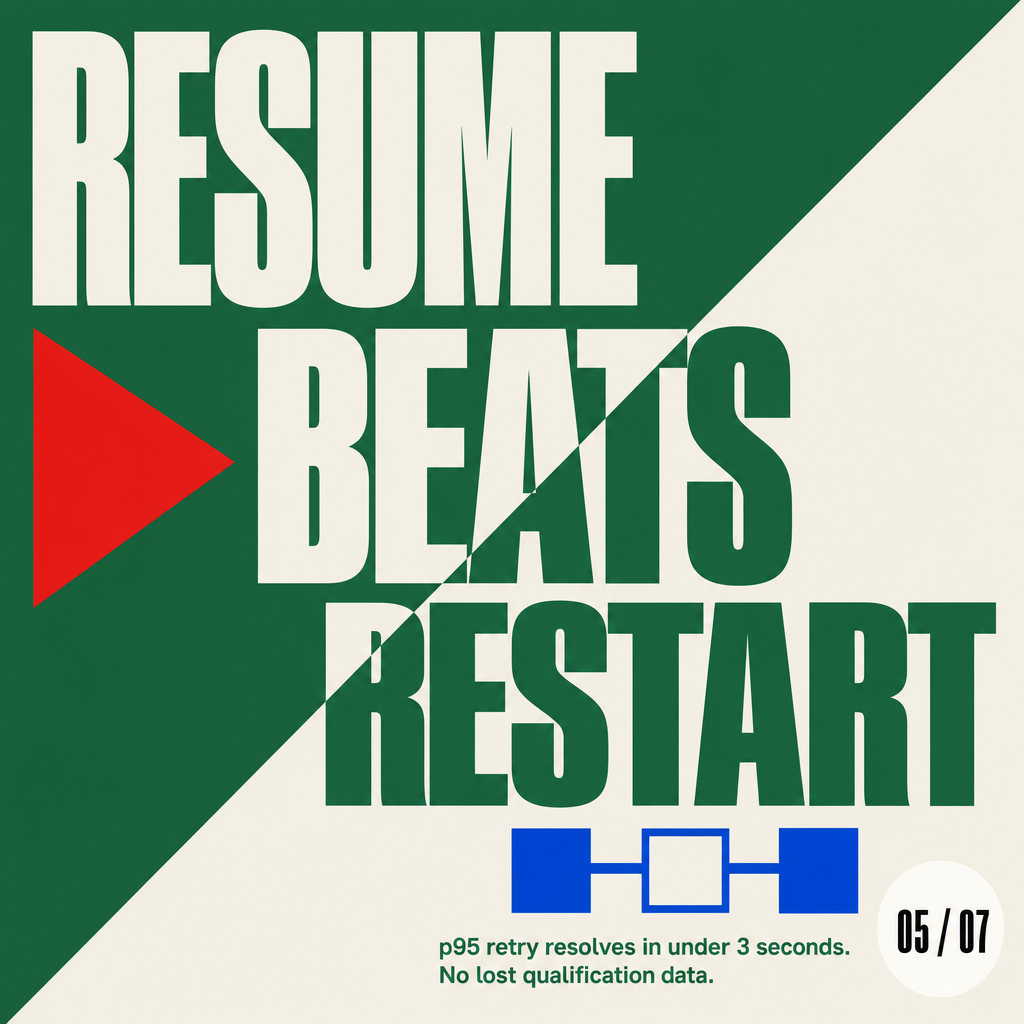
With Postgres, the retry flow looks like this:
- Read the session row for this contact and call ID
- Check which qualification steps have a confirmed value
- Inject only the confirmed fields into the model context as a brief summary
- Resume from the first unanswered step
- Write each new answer back to Postgres as it's confirmed
This is also where the cheap model first, expensive model on retry pattern pairs well. The retry call carries structured context, not a wall of transcript. A cheaper model can handle resumption. You only escalate to the expensive model if the call hits a point that needs better reasoning.
Is This Approach Relevant for Australian Compliance Obligations?
Yes. Postgres-backed state gives you an auditable record of every call attempt, which matters under Australian Privacy Act obligations.
The Office of the Australian Information Commissioner is clear that organisations handling personal information need to be able to account for what was collected and when. A voice agent that writes structured session data to a persistent store gives you that audit trail. Context-only agents don't. If a broker's client later asks what was captured during a qualification call, a Postgres row answers that question. A model context that no longer exists doesn't.
This isn't a compliance lecture. It's just a practical reason why persistent state is the right default, not an optional upgrade.
Key Takeaways
- Production agents that rely on context window state alone will fail when calls drop, retry, or restart.
- Persisting state to Postgres lets retries resume mid-qualification rather than starting over.
- Structured state in Postgres reduces token usage on retries and supports a cheaper-model-first cost strategy.
- An auditable session record is good practice under Australian privacy obligations, not just a technical nicety.
If you're building voice AI for finance, insurance, or real estate clients and you're not sure how your current stack handles dropped calls or retries, that's worth a closer look. DM AUDIT and I'll send you five questions that'll show exactly where the gaps are.
Frequently Asked Questions
Written by Syed Bilgrami
Founder of TheAutomate.io, building AI voice agents for Australian businesses